
Golden Pencilfish | Nannostomus beckfordi
Characins / Lebiasinidae / Golden Pencilfish
Profile: Golden Pencilfish, Beckford's Pencilfish
Nannostomus beckfordi Synonyms: Nannostomus anomalus, N. aripirangensis
Physical description: This elongated fish, varies greatly in color depending on the geographical location from which it originated. A thick, dark band extends from the snout to the base of the caudal fin. The tall dorsal fin ranges in color depending on the fish's body color.
Size/Length: To 2.5" (6.4 cm)
Similar species: One-lined Pencilfish ( Nannobrycon unifasciatus), Dwarf Pencilfish ( Nannostomus marginatus ).
Habitat: Thickets of shallow vegetation in small brooks and creeks. South America; French Guyana, Guyana, and Brazil in the Rio Negro and middle Amazon.
S: middle, top
Aquarium: 20" (50 cm) or 10 gallons (38 L). The tank should be well-planted with fine-leafed plants (possible spawning site) and have a partial cover of floating plants to diffuse the light. Arrange the tank in dark colors with dark gravel. This fish prefers clean, peat-filtered water.
Water chemistry: pH 6-7.5 (6.7), dH 1-18 (5), 72-81°F (22-27°C)
Social behavior: A peaceful fish best kept in schools. Combine with other peaceful fish including small characins and catfish. Unlike other species in this family, Beckford's Pencilfish can be combined with more lively fish. Males often battle with each other, although neither fish is ever injured.
Suggested companions: Tetras, Corydoras, Loricarids, Killifish, Apistogramma, Discus, Hatchetfish, Rasboras, Danios.
FOOD: Live; Brine Shrimp, bloodworms, glassworms, Tubifex, mosquito larvae, Cyclops, Drosophila ; also takes dry foods
SEX: Males are slimmer with brighter red colors.
Breeding techniques: Use a small tank with a pH from 6.0 to 7.0, soft to medium water (1-6 dH), and a warm temperature of 82-86°F (28-30°C). Place as many fine-leafed plants as possible in the tank along with Java moss. The lighting should be dim. Spawning is initiated when the male pokes the female's abdomen. Pencilfish are notorious egg-eaters and often eat the eggs are they are dropped. Try using a pipette to suck up the eggs, before this occurs. Remove the pair or the eggs to a rearing tank. The transparent eggs hatch in 24-36 hours and the fry are free-swimming after 6 more days. At this time, the fry swim near the surface of the water and should be fed with roftiers, newly hatched Artemia, and powdered foods. When the young begin to swim at a lower water level, they can be fed larger foods. With frequent partial water changes, the young will grow quickly, even beginning to develop adult colors as soon as five weeks.
Breeding potential: 5. Breeding is fairly easy as long as the eggs are separated from the parents in time.
Remarks: Beckford's Pencilfish occasionally has problems with acclimation. It is normal for individuals to be shy and lose color for the first weeks in a new tank. There are several different color forms available. The color of this fish greatly depends on its geographical habitat. Several sub-species have been described. Beckford's Pencilfish is the easiest of its genus to care for and breed. When excited, the colors of this fish are intensified.
Difficulty of care: 3. A hardy, peaceful fish ideal for small community tanks.
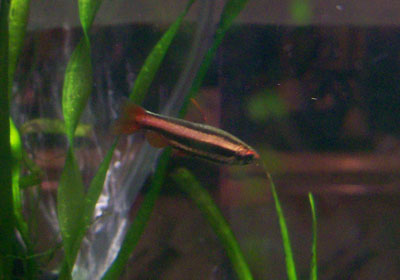
Nannostomus beckfordi. Photo by Holly Tjaden.