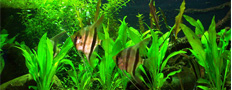
Arowana, Arawana [] Osteoglossum bicirrhosum Synonyms: �Isochnosoma bicirrhosum, Osteoglossum vandelli
Physical description: An elongated, slender fish with lateral compression. The scales are large and the head is covered with bony plates. The long anal and dorsal fins extend from the midsection of the body and run to the tail. The pelvic fin is a long, slender, sharp ray, while the pectoral fin is also very slender. These fins are white to silver in color, but may darken with age. The mouth is hinge-like and can be opened widely. Two barbels, which range in color from black to blue to green to red, are located on the lower jaw. The body color ranges depending on the sex, age, and habitat of the individual. Usually the Arowana is white with a silvery iridescence, but is often pink with a rainbow iridescence. The pinkish fish are often referred to as the "Rainbow" or "Salmon" Arowana. The Arowana has two large black spots that fade with age. The first is located in front of the gill cover and can only be seen on young individuals. The second is located behind the gill cover and is dark black with a copper colored mark located next to it. The eyes are large and dark.
Size/Length: Specimen measuring 60" (152 cm) have been caught by fishermen in the Amazon Basin, although the Arowana rarely exceeds 44" (110 cm) in captivity.
Similar species: Black Arowana ( Osteoglossum ferreirai), Asian Arowana ( Scleropages formosus ), Silver Barramundi ( Scleropages jardini)
Habitat: South America; the flood plains of the Amazon River and its tributaries.
S: Top
Aquarium: Young fish (under 6") should not be kept in tank measuring less than 36" (91 cm) or 35 gallons (132 L). Fish measuring up to 15" (38 cm) can tolerate a 48" (122 cm) or 55-70 gallon (209-266 L) tank. Eventually a considerably larger tank will be needed. The tank should be well-covered for Arawanas are fine jumpers. Use a dimly lit tank that is arranged in dark colors and has a cover of floating plants. The tank can be well planted with sturdy plants. An efficient filter is required that can remove large amounts of waste, but not create too much surface disturbance.
Water chemistry: pH 6-7 (6.7), 2-15 dH (8), 75-86°F (24-30°C)
Social behavior: The Arowana is a large predator that will consume smaller tank mates. This species is aggressive towards similar species and should be singly instead of in pairs or groups. Only combine the Arowana with large, robust species of lower swimming levels.
Suggested companions:� Astronotus, Anostomus , Cichlasomines, Loricarids, Colossoma, Leporinus, Mylossoma, Pseudoplatystoma, Serrasalmus, Sorubim
FOOD: Live; fish, spiders, large flying insects, Tubifex; may accept pellets and flakes
Sexual differences: Males have a longer anal fin while females are usually fatter when mature.
Breeding techniques: Breeding has only been accomplished a few times in an aquarium because fish become too large. On most occasions, spawning has occured in a tank exceeding 1000 gallons (3780 L). The eggs are 0.5" (1.3 cm) in diameter. The male mouthbroods the eggs for seven to nine weeks. The fry, measuring 3 or 4" (8-10 cm), leave his mouth after their egg sacs are gone.
Goulding documented spawning in nature. As flood waters rise, the cheek spot of male Arawanas, turns bright pink. Females are attracted to males with bright pink cheek spots, as this indicates that sperm is ripe. The female produces 150 to 200 eggs, which after fertilization, are taken into the protection of his mouth. The young hatch and remain in the mouth of the father. The yolk-sac is used up in 2 or 3 weeks, after which, the male lets them out to feed on microorganisms such as algae, tiny crustaceans, and insects. When danger approaches, the male's chin barbells are used to coax the young back into the safety of his mouth. After 4 to 6 weeks, the young are abandoned to fend for themselves. ��� Breeding potential: 10. Not feasible in captivity.
Remarks: These fish are only suitable as a juvenile for most private aquariums. After they outgrow their tank, it is often hard to sell them and it may be best to donate them to the local public aquarium. They grow very fast, often more than 12" (30 cm) in their first year. Avoid purchasing a fish with an egg sac for the fish is very delicate at that time. When frightened, these fish are likely to swim frantically around the tank, throwing themselves against the tank cover and the tank sides. Often, self inflicted injuries result. The Arowana is an excellent jumper, capable of leaping six vertical feet from the water. During the flood season, the Arowana has been known to use this ability to snatch young monkeys and sloths that are drinking. Unfortunately, most wild-caught juveniles are caught in a very brutal manner. Fishermen can recognize male Arowana with young in their mouth by their colored cheek patches and swollen lower jaw bones. When such a male is spotted, fishermen use an ax in an attempt to sever its head. Severing the head, prevents the male from killing the young by swallowing them, which is usually the reaction when the male is captured with a net. As the young flee the decapitated head, they are captured.
Difficulty of care: 8. The Arowana is a hardy, predatory fish that requires a diet consisting of live foods. The Arowana quickly outgrows its tank and subsequently must be moved. Perhaps this species is best left in its natural habitat and not cramped in a person's aquarium.
The copy for tropicalfreshwaterfish.com was written in 1994-1995. Therefore some information such as scientific names may be out of date. For this, I apologize. Feel free to send corrections to me.